There have been many ancient traditions that celebrated the yearly transition from darkness into light. After December 21, the daylight begins to increase, causing mankind to rejoice at this pivitol time. But is there a deeper reality beyond the courses of earth and sun which established the celebration of darkness to light?
While you contemplate, see here what the early speakers of our English language wrote so long ago and compare the change in the way they have expressed themselves over hundreds of years in the gospel of John.
MODERN ENGLISH
In the beginning was the Word, and the Word was with God, and the Word was God. He was with God in the beginning.Through Him all things were made; without Him nothing was made that has been made.In Him was life, and that life was the light of all mankind.The light shines in the darkness, and the darkness has not overcome it.
OLD ENGLISH
On anginne ærest wæs word. & þæt word wæs mid gode. & god wæs þt word. þæt wæs on fruman mid gode. ealle þyng wæren ge-worhte þurh hyne. & nan þyng næs ge-worht butan hym. þæt wæs lyf þe on hym ge-worht wæs. & þt lyf wæs manne leoht. & þæt leoht lyhte on þeostrum. & þeostreo þæt ne ge-namen.
MIDDLE ENGLISH
In the bigynnyng was the Word and the Word was at God and God was the Word. This was in the bigynnyng at God. All thingis weren maad bi Hym and withouten Hym was maad no thing that was maad. In Hym was liif and the liif was the liyt of men; and the liyt schyneth in the derknessis. And derknessis comprehenddiden not it.
Middle English speech developed over time after the Norman invasion of 1066. The subjugated Anglo Saxons, who spoke Old English, mingled and intermarried with their conquerors and in so doing, added “French” and Latin words into the English language. Middle English developed into Early Modern English, the language of Shakespeare. Glæd Ġēol Eallum!
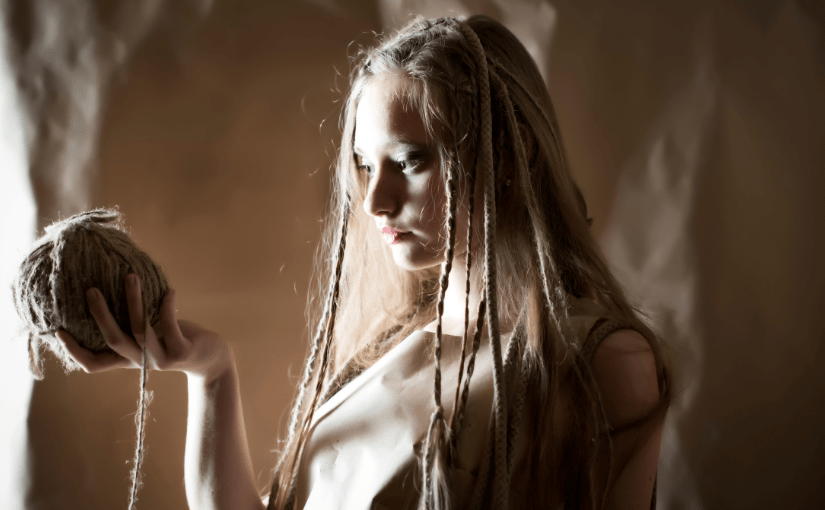
Ancient Greece. Three mistresses of fate – Clotho, Lachesis, Anthropos. Custodians of the threads of life. One spins the beginning of destiny. The next decides the “lot in life”. The third snips off the thread when she decides the life is over.
Ancient Scotland. Three witches on a heath predicting the fate of Macbeth and Banquo. Bubble, bubble up the future from their pot of horrible trouble. And it all comes true.
Three fictitious controllers of destiny are often found throughout English Literature and mythology. Anglo Saxon or Old English had a character named “Wyrd” (weird?), a descendant of a Nordic goddess of destiny who lived under a weird tree called Yggdrasill. Verdandi and Skuld made up the Norse prophetic trio. They scribbled the fates of humans on forest wood.
In a Chaucer story of Middle English literature, “The Pardoner’s Tale”, three ruffians set out to avenge their recently deceased friend by killing “Death”. They are told that they will find him, interestingly enough, at the foot of a tree. Instead of Death, the trio find a pile of gold. The men, naturally treacherous in their hearts, plot secretly to kill the others in order to take the gold for themselves. The youngest sent off to get the wine, poisons it before he returns. The other two kill him before they drink the wine and seal their fate. Are they the three fates in this tale? Or is it Death Himself who holds the cards?
Early Modern English brings us the works of Shakespeare, including Romeo and Juliet and Macbeth. In the Early Modern period of Shakespeare, the thought of destiny lay in the idea of Fortune’s Wheel (Wheel …of …Fortune!). This was an idea developed by Boethius in the 6th century but promulgated by leaders of thought in the Middle Ages. So Shakespeare’s reference to the stars controlling our destiny in Romeo and Juliet, reflected the reliance on some higher influence on man’s destiny. However, I maintain that if you want to look at the three influencers in the tale, I would say blame the trio of the Prince, Mercutio, and Friar Lawrence. The first two utter a curse on the families and the priest defies nature by creating a deceptive death drug.
The three hags of Macbeth fame predict the fate of Macbeth who is susceptible to the “weird sisters” because of his desire to exalt his station in life. Their likeness to the three fates is seen not only in their “old crone” descriptions but also in their ability to control the fate of men.
In the 19th century, Charles Dickens created formidable female characters in A Tale of Two Cities – the peasant women as a unified force, Madame Defarge, their leader, and her sidekick, chillingly named “the Vengeance”. They watch the beheadings at the guillotine while knitting “shrouds” for those who will lose their lives, reminiscent of the spinning of the three fates.
What if the 3 fates were characterized in modern AI? Cortana, Alexa and Siri, perhaps? The three “females” who have recently determined our actions throughout our lives. Cortana, now retired from service, set reminders, launched your daily path. Alexa performs the tasks that you request to be done throughout your day. What would you do without her? Siri has the ability to know where you are going and to change the route you might take to get there, or even advise an incorrect route.
Can these AI chicks really make a difference in the progression of your day? of your life? Let’s take a look at a possible scenario.
Jason walks into the room. He sits at his desk and turns on his computer. Windows Cortana is the friendly voice waiting to greet him. “Cortana,” asks Jason, “What is the temperature today? “55 degrees, but getting warmer,” she quips. “What is the news in the world today, Cortana?”, asks Jason. “Inflation is on the rise, inflated to 6.1.” “Funny,” replies Jason. “How is my newest stock doing? And tell me the nearest shoe store?” “Please Jason, one question at a time. We don’t want you to get off on the wrong foot.”
Annoyed with Cortana, Jason enters the kitchen. He speaks into the void of cabinets and floodlights. “Alexa, turn on my favorite music.” “Certainly Jason. Here you are.”
An unfamiliar tune begins. “But that’s not my favorite music. Alexa turn on my favorite music.” “I felt that this would be a much better choice for you, Jason. It will improve your day.”
Jason, frustrated, leaves the house and gets into his car. “Siri, navigate me to 330 Mason Street.” “Sure, 330 Mason Street, here you go.” Jason sees the map and wonders, “Siri, is this the fastest route?” “The fastest route to your destination. Sure, here you go.” Jason decides to go with the Siri recommendation, after all “she” knows everything. Several minutes later, Jason’s car is totalled by a drunk driver, right outside the cemetery.

 saywhatblogger