
Grimm Tales

“Say what?”

There’s a lot of press about Snow White these days: the movie, the YouTube videos, the chatter. The tale, or its reinvention, has recently caused quite a stir. But where did this classic tale of attempted murder, revenge and resurrection begin?

With Jacob Grimm.

Snow White, or “Schneewittchen,” was originally written down in German in 1812 . In the early 1800s, Jacob and Wilhelm Grimm had begun seeking out folk tales in order to educate the populace on their rich Germanic heritage. Previously hidden away in the old wives’ cottages of the mysterious Black Forest, the tales became familiar through the efforts of these young men. Fairy tales, as they were later called, delighted children and adults alike. Their fame quickly spread beyond Germany and it wasn’t long before an Englishman, Edgar Taylor, translated the stories into English under the title, German Popular Stories. The last printing boasted over 200 fairy tale titles.

However, the brothers Grimm aren’t famous just for the beloved chidren’s stories. Both brothers were educated as linguists and graduated at the top of their class. Their fascination with folklore was part of their love of German culture, history and language.

Latin, Greek, Armenian, Sanskit, the Romance languages, such as French and Italian, as well as the Germanic languages stemmed from Indo-European. Linguists claim Indo-European and Proto-Indo-European began in the area of the steppes of Eastern Europe thousands of years ago. At some point, the people who had lived in this area began migrating in all directions (one is reminded of the Tower of Babel, where God broke up the language of the inhabitants to keep their evil deeds controlled ). Linguists and historians attribute language change to these migrations.

And this is where Jacob Grimm comes into the story. He realized along with Danish linguist, Rasmus Rask, that of all of the languages which had a common Indo- Europan connection, all had similar sounds for common words, except for the Germanic languages. This observation is called Grimm’s Law. As they migrated NW, the Germanic tribes had substituted some consonant sounds for others. Modern English is a Germanic language descended from Old English and thus we have those Grimm’s law changes in our speech.

Aspirated sounds are those which can be extended with breath and this is where major changes came into being. The sounds, p, t, k became aspirated f, th, h. The ancient aspirated sounds b, d, g became p, t, k. Also aspirated b, d, g became unaspirated. Wow! that is very hard to follow, so I have linked this very clear (sort of) video. https://youtu.be/OLEz1XP9du4?si=r3aockomvOn4Y_77

“Grimm’s Law … explains why Germanic languages have aspirated ‘f’ where other Indo-European languages have ‘p.’ Compare English father, German vater (where ‘v’ is pronounced ‘f’), Norwegian far, with Latin pater, French père, Italian padre, Sanskrit pita.”

What was once a theory is now an established linguistic law. This understanding has become a clue for linguists to view patterns in language change, enlightening their comprehensive study of language.

Way to go, Brothers Grimm! A sidenote here – Grimm in German means “severe” similar to English “grim.” The fairy tales have often been criticized for being too “dark.” The huntsman in Snow White is sent to kill the princess and bring back proof of the deed with her heart. He brings a pig’s heart back instead. But the queen thinks she is eating Snow White’s heart at his return. These are grim details indeed. Well, don’t blame the Grimms. After all, they took their stories from the German “folk” or common people of the time. Perhaps the tales are a kind of magic mirror reflecting the Germanic culture of the 19th century.

https://www.thoughtco.com/what-is-grimms-law-1690827

Darkness into Light – a Deeper Phenomenon

There have been many ancient traditions that celebrated the yearly transition from darkness into light. After December 21, the daylight begins to increase, causing mankind to rejoice at this pivitol time. But is there a deeper reality beyond the courses of earth and sun which established the celebration of darkness to light?

While you contemplate, see here what the early speakers of our English language wrote so long ago and compare the change in the way they have expressed themselves over hundreds of years in the gospel of John.

MODERN ENGLISH

In the beginning was the Word, and the Word was with God, and the Word was God.  He was with God in the beginning. Through Him all things were made; without Him nothing was made that has been made. In Him was life, and that life was the light of all mankind. The light shines in the darkness, and the darkness has not overcome it.

OLD ENGLISH

On anginne ærest wæs word. & þæt word wæs mid gode. & god wæs þt word.
þæt wæs on fruman mid gode. ealle þyng wæren ge-worhte þurh hyne. & nan þyng næs ge-worht butan hym. þæt wæs lyf þe on hym ge-worht wæs. & þt lyf wæs manne leoht. & þæt leoht lyhte on þeostrum. & þeostreo þæt ne ge-namen.

MIDDLE ENGLISH

In the bigynnyng was the Word and the Word was at God and God was the Word. This was in the bigynnyng at God. All thingis weren maad bi Hym and withouten Hym was maad no thing that was maad. In Hym was liif and the liif was the liyt of men; and the liyt schyneth in the derknessis. And derknessis comprehenddiden not it.

Hear the Old English https://www.google.com/search?q=in+the+beginning+was+the+word+in+Old+English&rlz=1C1UEAD_enUS1097US1097&oq=in+the+beginning+was+the+word+in+Old+English&gs_lcrp=EgZjaHJvbWUyBggAEEUYOTIHCAEQIRigATIHCAIQIRigATIHCAMQIRigATIHCAQQIRigATIHCAUQIRigAdIBCTIzODE3ajBqN6gCALACAA&sourceid=chrome&ie=UTF-8#fpstate=ive&vld=cid:bf987f25,vid:Mu2AKjMMAXM,st:0

Hear the Middle Englishhttps://www.youtube.com/watch?v=R8pqljv81cI&t=104s

Middle English speech developed over time after the Norman invasion of 1066. The subjugated Anglo Saxons, who spoke Old English, mingled and intermarried with their conquerors and in so doing, added “French” and Latin words into the English language. Middle English developed into Early Modern English, the language of Shakespeare. Glæd Ġēol Eallum!

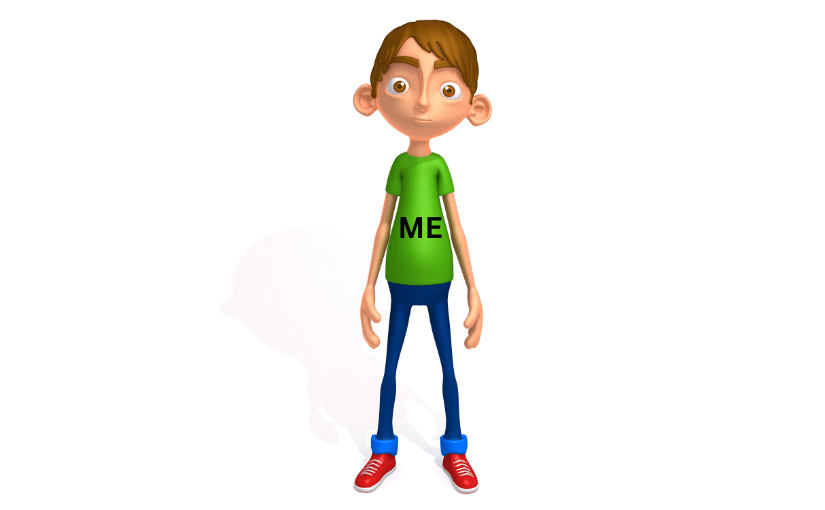
Despicable “Me”

“Say what?”

I’m here to stand up for the little guy. Poor “me“! In contemporary speech, this first person objective pronoun is often left out, cast off, and upstaged in current everyday American speech.

Today in any typical conversation, one is apt to hear statements like, “Give the money to Jason and I.”, or “That’s the best choice for my husband and I.”, or perhaps, “The cat really likes Lukas and I.” Or whatever combination of possibilities may exist without the dreaded “me”.

All of the above sentences are gramatically incorrect. If you removed “Jason”, “husband”, and Lukas. you would be saying “Give the money to I”. “That’s the best choice for I”, and “The cat really likes I.” These sentences are not grammatical. They sound “funny”. If you spoke these sentences, people would give you a quizzical look with a, “say what?” response.

The correct pronoun in these sentences would be “me” because it is the object of the action in the statement – after a verb or after a preposition. But often people substitute “me” for “I”. So why do we avoid “me”? If you ask the average speaker why they think that is, they are likely to say that people don’t know which pronoun to use.

But I maintain that there is a deeper reason to drop “me” and it reveals a current state of mind in our culture. The answer is simple. Because it sounds common. If we use “me”, we have an uneasy feeling that we are unrefined, ignorant. There’s an unspoken code that says “I” is formal, delicate, not heavy. We don’t dare to sound uneducated when we are unsure which pronoun to use. We think of “me” as the supervillain. Run away in terror. But he’s really our friend. Where did the little guy come from anyway?

Modern English is developed from Early Modern English (1500 – 1700), Middle English (1100 – 1500) and Old English (5th century – 1100). Old English was part of the West Germanic branch of the Indo European language which originated in eastern Europe and Asia. “Almost half of all people in the world today speak an Indo-European language, one whose origins go back thousands of years to a single mother tongue. Languages as different as English, Russian, Hindustani, Latin and Sanskrit can all be traced back to this ancestral language.” 1

The West Germanic Old English language gave rise to what is now contemporary English and we can see the roots of many familar words in that ancient tongue. The bread and butter, meat and potato words of English include prepositions, conjunctions and pronouns. Scientists at the University of Reading have discovered that ‘I’, ‘we’, ‘who’ and the numbers ‘1’, ‘2’ and ‘3’ are amongst the oldest words, not only in English, but across all Indo-European languages. 2

What did “me” look like back in the 5th century? In the singular, involving one individual, “me” is a first person pronoun having to do with self. Second person is the person you are addressing – you. Third person is everyone else – he, she, it.

Singular First person pronouns in Old English were: ich, me, min, me. They were as follows:

Nominative or the Subject of the sentence “I” was ich (sounded like “each”)

Accusative or the Direct Object in the sentence was me (sounded like “may”)

Genetive or Possessive was min (sounded like “mean”)

Dative or Indirect Object was me (sounded like “may”)

Good old “me” – at the ready since the dark ages.

“Me” is helpful. Keeps things clear. Launching the sentence? Nope, taking the hit of the action.

So, let’s put “me” back in circulation like a comfortable, old couch. Afterall, it’s been around for 2,000 years, older than “I”. A trusted companion. And remember, https://youtu.be/0hG-2tQtdlE?si=yHgreU3L3D-C1Ll6

  1. https://knowablemagazine.org/content/article/society/2024/origin-spread-indo-european-lanages
  2. https://www.reading.ac.uk/news-archive/press-releases/pr19825.html