
Tick Tock

“Say what?”

Tick Tock. Tock Tick.

Mmmm, that doesn’t sound quite right.

Nor does flam flim, or dong ding, hop hip, or song sing. Why? might you ask. You know instinctively that those are …”just wrong”. But you ponder – Why? What ancient linguistic police decided these expressions were incorrect?

The truth is that these pronunciations are instinctive to the English language. And why, you may ask?The answer to the 24,000 dollar question is – the placement of the vowel sounds in our mouths.

There are high vowels, mid vowels and low vowels. Countless acting students have learned to “speak with distinction” from the Edith Skinner method of speech. And in mocking tones, the students joke that they “mutht thpeak with dithtinkshun.” But this is no laughing matter. To aid in clear speech, as well as dialect speech for performing, the actor would do well to discover the placement in the mouth for proper pronunciation of English words as well as correct dialects of any kind. Short i, e, a, and ah, aw are the sounds made by placing the lips and teeth highest, lower and so on in the mouth. It is natural to form the highest placed vowel first and move onto the lower placement as in “tick tock” rather than “tock tick”. It’s just easier to do. This is called ablaut reduplication by linguists. The standard explanation of how we determine the vowel progression is described as short I, followed by short A and if a third vowel sound, short O. In other words, the vowel sounds of the repeated word or phrase are I,A or I,A,O. This phenomenon also occurs in other languages because, hey, we all have the same mouths. However it should be noted that this vowel pattern goes all the way back to the origin of many languages, Proto-Indo-European and Indo-European, which I mentioned in a previous post. Proto-Indo-European and Indo-European began in the area of the steppes of Eastern Europe some 4,000 yeras ago. Sanskrit, Hindi, Farsi, German, French, Latin are some of the languages that stem from that Mother Tongue.

There’s also a natural rhythm expressed with the stresses in the common words and phrases we use. There was an old convenience store with the name White Hen Pantry, the sound of which drove me nuts and I never knew why that was so. I always said it should be better to say White Pantry Hen. Why? Because of the stressed and unstressed pronunciation. If a stress on a syllable is marked as / and the unstressed as __ , the first store name is / / / __ , and the second name, __ __ __ /. This is why iambic pentameter, ( __ /, or unstressed, stressed) is the most common stress pattern in poetry, particularly in Shakespeare’s verse. “Light through her window breaks” doesn’t have the same appeal as “What light through yonder window breaks”. The latter is iambic pentamenter – unstressed/stressed. Why do our ears prefer that pattern? Well, it has been suggested that our heartbeat is iambic pentameter (da dum da dum) and therfore unstressed/stressed is attuned to our own bodily rhythm.

https://www.bbc.com/culture/article/20160908-the-language-rules-we-know-but-dont-know-we-know
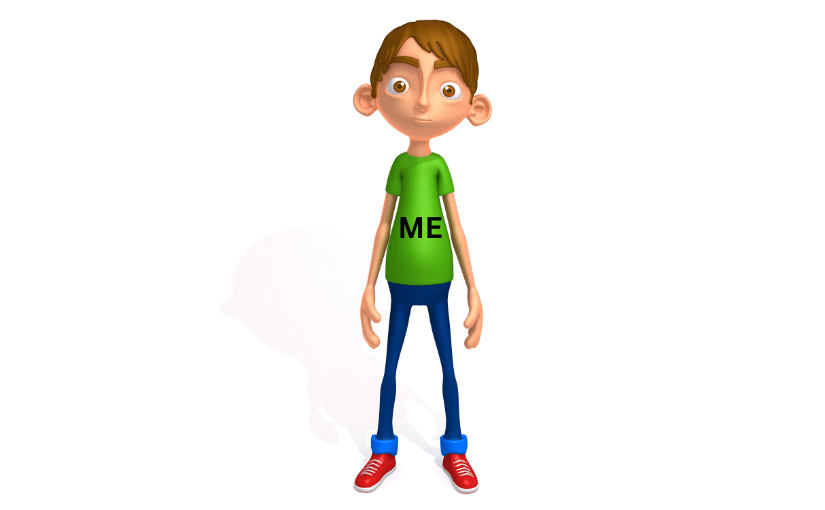
Despicable “Me”

“Say what?”

I’m here to stand up for the little guy. Poor “me“! In contemporary speech, this first person objective pronoun is often left out, cast off, and upstaged in current everyday American speech.

Today in any typical conversation, one is apt to hear statements like, “Give the money to Jason and I.”, or “That’s the best choice for my husband and I.”, or perhaps, “The cat really likes Lukas and I.” Or whatever combination of possibilities may exist without the dreaded “me”.

All of the above sentences are gramatically incorrect. If you removed “Jason”, “husband”, and Lukas. you would be saying “Give the money to I”. “That’s the best choice for I”, and “The cat really likes I.” These sentences are not grammatical. They sound “funny”. If you spoke these sentences, people would give you a quizzical look with a, “say what?” response.

The correct pronoun in these sentences would be “me” because it is the object of the action in the statement – after a verb or after a preposition. But often people substitute “me” for “I”. So why do we avoid “me”? If you ask the average speaker why they think that is, they are likely to say that people don’t know which pronoun to use.

But I maintain that there is a deeper reason to drop “me” and it reveals a current state of mind in our culture. The answer is simple. Because it sounds common. If we use “me”, we have an uneasy feeling that we are unrefined, ignorant. There’s an unspoken code that says “I” is formal, delicate, not heavy. We don’t dare to sound uneducated when we are unsure which pronoun to use. We think of “me” as the supervillain. Run away in terror. But he’s really our friend. Where did the little guy come from anyway?

Modern English is developed from Early Modern English (1500 – 1700), Middle English (1100 – 1500) and Old English (5th century – 1100). Old English was part of the West Germanic branch of the Indo European language which originated in eastern Europe and Asia. “Almost half of all people in the world today speak an Indo-European language, one whose origins go back thousands of years to a single mother tongue. Languages as different as English, Russian, Hindustani, Latin and Sanskrit can all be traced back to this ancestral language.” 1

The West Germanic Old English language gave rise to what is now contemporary English and we can see the roots of many familar words in that ancient tongue. The bread and butter, meat and potato words of English include prepositions, conjunctions and pronouns. Scientists at the University of Reading have discovered that ‘I’, ‘we’, ‘who’ and the numbers ‘1’, ‘2’ and ‘3’ are amongst the oldest words, not only in English, but across all Indo-European languages. 2

What did “me” look like back in the 5th century? In the singular, involving one individual, “me” is a first person pronoun having to do with self. Second person is the person you are addressing – you. Third person is everyone else – he, she, it.

Singular First person pronouns in Old English were: ich, me, min, me. They were as follows:

Nominative or the Subject of the sentence “I” was ich (sounded like “each”)

Accusative or the Direct Object in the sentence was me (sounded like “may”)

Genetive or Possessive was min (sounded like “mean”)

Dative or Indirect Object was me (sounded like “may”)

Good old “me” – at the ready since the dark ages.

“Me” is helpful. Keeps things clear. Launching the sentence? Nope, taking the hit of the action.

So, let’s put “me” back in circulation like a comfortable, old couch. Afterall, it’s been around for 2,000 years, older than “I”. A trusted companion. And remember, https://youtu.be/0hG-2tQtdlE?si=yHgreU3L3D-C1Ll6

  1. https://knowablemagazine.org/content/article/society/2024/origin-spread-indo-european-lanages
  2. https://www.reading.ac.uk/news-archive/press-releases/pr19825.html